Encounter completion — charges & finalize
Close out the visit: E/M and CPT charges, patient instructions, follow-up scheduling, medication reconciliation, favorites, signing the encounter and co-signing — and what to do when a signed visit needs to change.
Encounter completion — charges & finalize
Close out the visit: E/M and CPT charges, patient instructions, follow-up scheduling, medication reconciliation, favorites, signing the encounter and co-signing — and what to do when a signed visit needs to change.
Code the visit (E/M & CPT)
The Charges section captures the billing codes. Pick an Evaluation & Management level with one click and Hero EMR fills in the matching CPT; add any procedure or other CPT codes by search.
-
Choose the E/M level.
The buttons
Straightforward,Low,Moderate,High,New Low, andNew Moderatemap to the right code — e.g.Moderate→ 99214 — Established patient office visit, moderate complexity (30–39 min). Picking a level turns theE/Mtracker chip green. -
Add other CPT codes.
Use
Search CPT codesfor procedures, vaccines, or anything beyond the office visit.Managecurates your charge favorites, and is also where you rename or hide theNo chargebutton. -
Or close the visit without an E/M code.
Two pinned buttons sit at the front of the quick-button grid:
No charge— close the visit with no billing at all. Nothing is charged, no insurance claim is created, and the visit reports as “No billing” in the Billing Command Center. It is shown by default; you can rename it or hide it from your own charge favorites underManage.Cash pay— create a patient balance instead of an insurance claim. The caption under the button shows the configured price for this patient and visit type (a fixed Service Menu price counts even when it is hidden from patients). With no visit price but with billing codes on the visit, the cash price is worked out at signing from your CPT List Prices for those codes — and if one of those codes has no price, signing stops with “Cash pay needs a price for every signed code, and 99050 has none. Set a cash-pay amount for this visit, or ask billing to set a price for 99050 in CPT List Prices.” With no price and no codes, or for an Office review service, the caption reads Price required and an administrator or billing staff member with charge-management access enters a one-time amount before you sign. Where a price is configured, the same permission lets you override it for this visit only.
Create an insurance claim anyway in the Charges section.
Injections and other medicines given in the office
With In-office medications on, you don’t type drug or injection codes here. Each dose recorded in Medications given in clinic adds its own lines to Charges: the drug code with its units and NDC, JW or JZ, and the injection code such as 96372. Change those lines from Medications given in clinic, not here; see Billing for medications given.
Superbill or Good Faith Estimate for a patient paying out of pocket
When the visit is cash pay, the patient has no insurance on file, or the practice is out of network with their insurer (from the latest eligibility check, or your payer contracts), a bar in Charges says why — Cash pay., No insurance on file., or Out of network with {payer}. — and offers Superbill and Good Faith Estimate. Each saves the note first, then opens filled in from the codes and diagnoses already on this visit, ready to issue in two more clicks. The bar shows only to users who can see financial amounts: Superbill needs access to the patient’s invoices, and Good Faith Estimate needs admin or billing.charges.manage. A No charge visit shows no bar. The documents themselves are described under Financial documents.
Place of service
Place of service sits at the top of the Charges section, next to Manage. It is the CMS code the claim is filed with — where the service actually happened.
-
Leave it alone for an ordinary visit.
The selector starts on
Default, and the option names the code Hero EMR will use — for example Default · 11 Office, Default · 10 Telehealth, patient at home for a telehealth visit type, or Default · 22 On-campus outpatient hospital for a visit booked with an outside-facility visit type. Nothing changes from how visits have always been billed. -
Override it when you worked somewhere else.
Pick the place that matches; each option names its code:
Office (11),On-campus outpatient hospital (22),Inpatient hospital (21),Ambulatory surgical center (24),Off-campus outpatient hospital (19),Emergency room, hospital (23),Skilled nursing facility (31),Nursing facility (32),Independent clinic (49),Public health clinic (71),Home, in person (12),Telehealth, patient not at home (02)orTelehealth, patient at home (10).Home, in person (12)is for a visit at the patient’s home in person; a video visit with the patient at home isTelehealth, patient at home (10)(see Where was the patient?). An explicit choice is badgedOVERRIDE, and the claim is filed with it — the Billing Command Center will not flag it as the wrong place of service. -
Go back to the default.
Choose
Default …again at the top of the list. - The facility on the claim. When the code is a hospital or facility setting, Hero EMR puts the facility's name, NPI, and street address on the claim as the service facility (CMS-1500 box 32): the facility chosen when the visit was booked with an outside-facility visit type, or, for a visit booked at one of the practice's own locations, that location. Keep those details current under Visit Config and Locations.
Rounding visits linked to a hospital admission are the exception: their place of service comes from the admission's patient class, so the selector is not offered there.
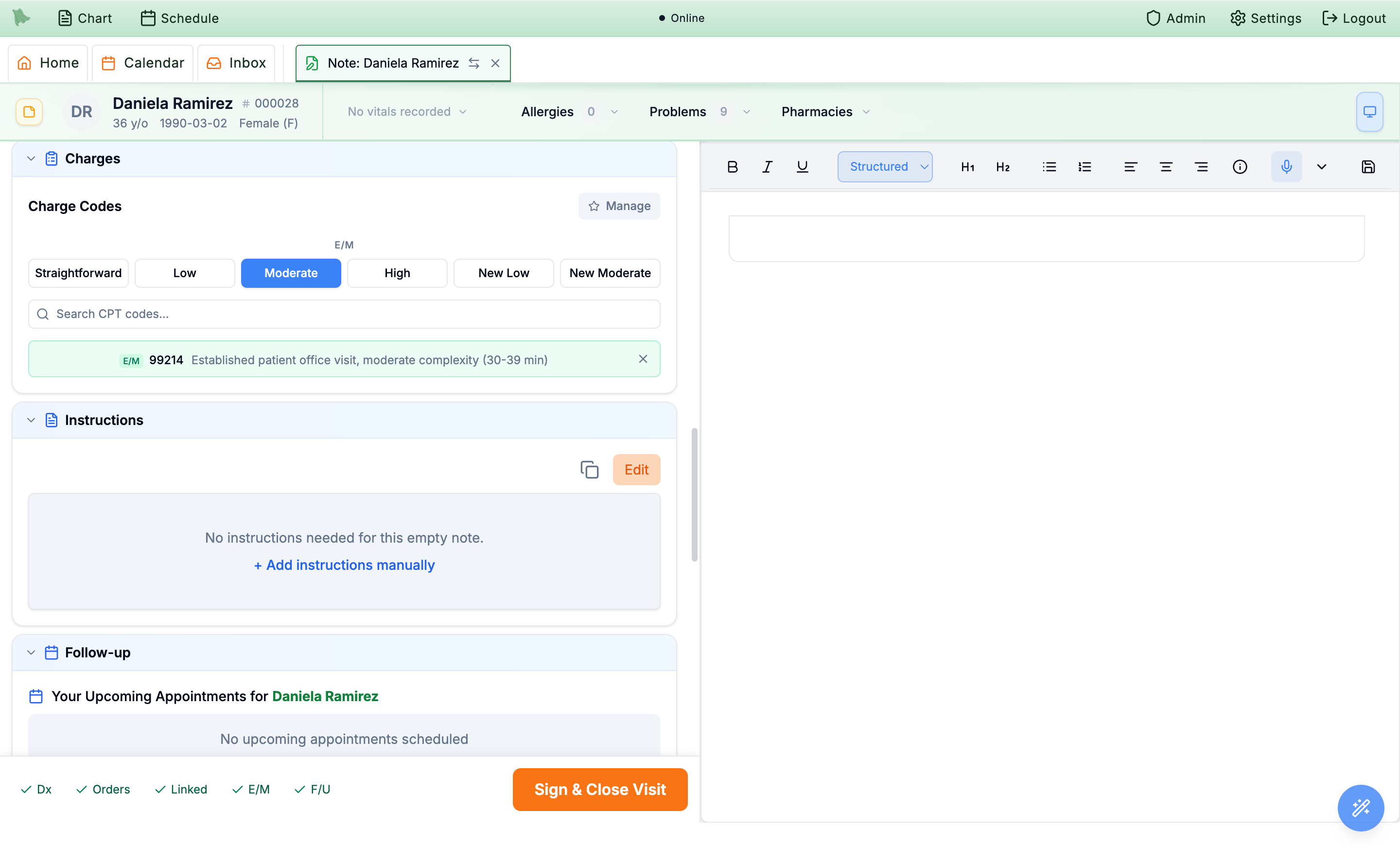
E/M tracker.Hospital visits and consultant stays
For a hospital stay, Your role on this stay distinguishes Admitting / attending from Consultant. Visit roles follow service-date order, so a backdated first visit can change which later visit is a follow-up. Check the role shown above charges before choosing the E/M code.
Hero warns about an initial-care or consultation code on a follow-up and about modifier AI when the visit is not the admitting/attending physician’s qualifying initial care. Signing checks the billed lines for hospital visits. Correct the stay or visit role and the codes when they disagree. An unsigned discharge note must be changed to an appropriate follow-up before switching a stay to Consultant; consultants do not write a discharge-management note through the discharge action.
Patient instructions
Hero EMR drafts after-visit patient instructions from your note. Review them, edit, or write your own, then they travel with the visit summary the patient receives.
- Review the draft. The
Instructionssection proposes plain-language instructions based on the note’s plan. - Edit or add your own. Use
Editto revise,+ Add instructions manuallyto write from scratch, orCopy to clipboardto reuse elsewhere.
Schedule the follow-up
The Follow-up section is pre-set from your note’s plan and lets you confirm the timing and book the next visit without leaving the encounter.
-
Check what’s already booked.
Your Upcoming Appointmentsat the top of the section lists this patient’s scheduled visits (date, time, visit type) so you don’t double-book a follow-up that already exists. -
Confirm the timing.
Pick
2 weeks,1 month,3 months,6 months, orCustom. Hero EMR shows a Recommended follow-up date based on your choice. -
Set the visit type and book.
Choose the
Visit Type.Durationbeside it is a read-only readout — it comes from that visit type’s default duration, so change the duration by changing the visit type (or its definition under Visit types). The star inside each visit-type option saves it as your default follow-up type (tooltip: Set as default follow up type).Schedule Nowdoes not create the appointment on the spot. It opens the scheduler in its own tab with the chosen visit type selected, on the follow-up’s due date — or the first day with openings after it — with that day’s first open time picked and a note such as “Follow-up due Nov 21 → first opening Mon, Nov 23” (or “Follow-up due Nov 16 has openings”). Change the time if you like, then pressBook. The booked visit is linked back to this follow-up.- Or leave it as a follow-up request to be booked later. The
F/Utracker chip turns green once set.
-
Once a visit is on the calendar.
The request UI is replaced by a
Follow-up appointment scheduledpanel showing the date, time, and visit type, withRescheduleandCancel appointmentbuttons. As it says there, the automatic follow-up request is turned off while that appointment is on the calendar — the two are mutually exclusive.
Review medications during the visit
The Medications section shows the same list as the chart’s Medications tab in a compact form. It has the same groups (Needs review, Current, Scheduled, On hold and Past), the same names and release badges, the same supply lines and the same buttons. It also shows which chart medications this visit reorders, alongside what you are prescribing today and what you are stopping when you sign. Collapsed, the section header sums it up, for example 7 current · 2 to review · 1 stopping at sign · 1 new prescription.
-
Watch the footer chip.
The footer always shows a
Medschip next toDx,Orders,E/MandF/U, for exampleMeds 7 · 2 to review. It turns amber while anything needs review, and clicking it jumps to this section. Its numbers always match the section’s group headers and the chart tab. With medication reconciliation on, it also shows(N pending)or(N to reconcile). -
Check
Prescribing today. Prescriptions in this visit’s Orders that are not on the list yet appear at the top, each markedDraftorSent. The block isRead only. Change a prescription in Orders. -
Work
Needs review. Rows that ran out, that the patient reports not taking, that couldn’t be matched or that were imported without a status offer the same buttons as on the chart:Reorder,Still taking,Specify,Merge, andStop at signin place ofStopped. The chart tab explains what each one does. -
Reorderadds the prescription to this visit. Inside an open visit,Reorderdoesn’t open a separate order. It adds the renewal to this visit’s Orders, filled in from the last prescription with the product, directions, quantity and days’ supply, set to 0 refills and linked only to diagnoses already on the visit. Hero then expands Orders and opens the prescription inEdit Medicationso you can check it. The summary at the bottom of the dialog showsLast sent to:and the earlier pharmacy. If this visit’s pharmacy is different, it says so, so you can switch underPharmacyif the patient wants the earlier one. The renewal is signed and sent with the visit like any other order. ClickingReorderagain opens the one already staged (“already in this visit’s orders”) instead of adding a second. The renewal is for the product the chart lists, so if you usedSpecifyto pick the ER form, the ER form is what gets renewed. If there is no prescription on file to copy, or Hero can’t confirm the product or how it is dispensed, nothing is added. Instead Hero opens the order search with the medication’s name (“Choose the product for …”) so you pick it. A signed visit takes no new orders, so renew from the chart instead. -
Stop a medication at sign.
Rows in
Current,ScheduledandOn holdcarryStop at sign. Clicking it turns the row amber with aStopping at signchip and aDiscontinuation reasonbox, so you can document why. The button becomesKeepin case you change your mind. The row leaves the counts straight away, and the medication is discontinued when you clickSign & Close Visit. The note above the list says so: “Use ‘Stop at sign’ to discontinue a medication when this encounter is signed.” -
Check stops Hero suggested.
When Hero reads a stop in your note, it queues it for you. The row shows
Stopping at signplus aSuggestedchip, and it will be discontinued at sign like your own stops. If the patient should stay on it, clickKeep. With medication reconciliation on, suggestions work differently: nothing is queued, and the row showsSuggested stopwithDiscontinueandDismiss(see The workspace).
AI-suggested reorders stay linked to the existing medication. Pressing Reorder accepts that suggestion or opens the reorder already staged, avoiding a duplicate. Orders tags the prescription as a reorder. A new reorder clears a queued stop for the same medication; stopping an unsent reorder asks you to Keep reorder or Remove reorder and stop. A prescription already sent or locked cannot be silently removed.
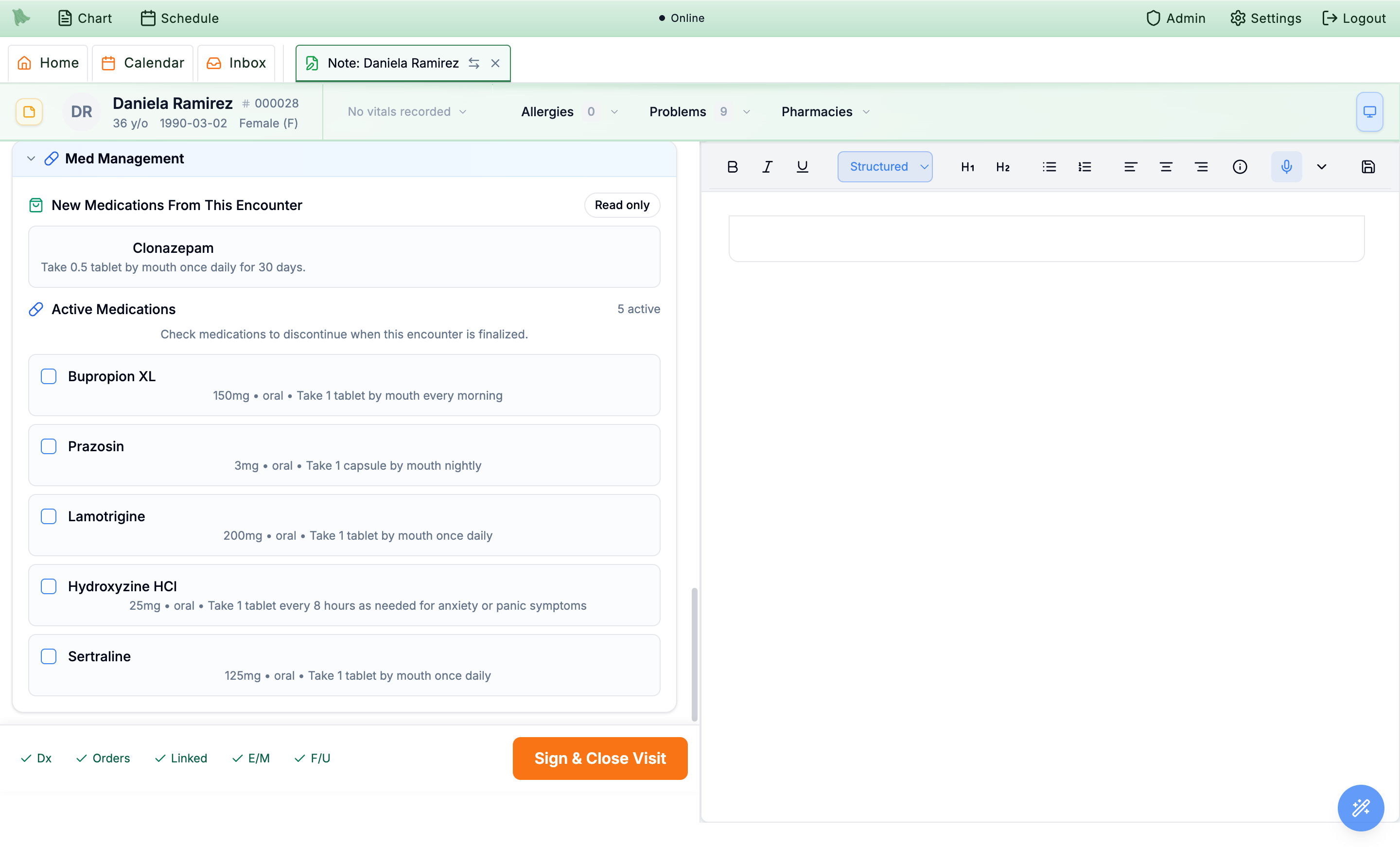
Prescribing today, one row is queued to stop at sign (with a reason box and Keep), and the footer chip already leaves the stopping row out of the count.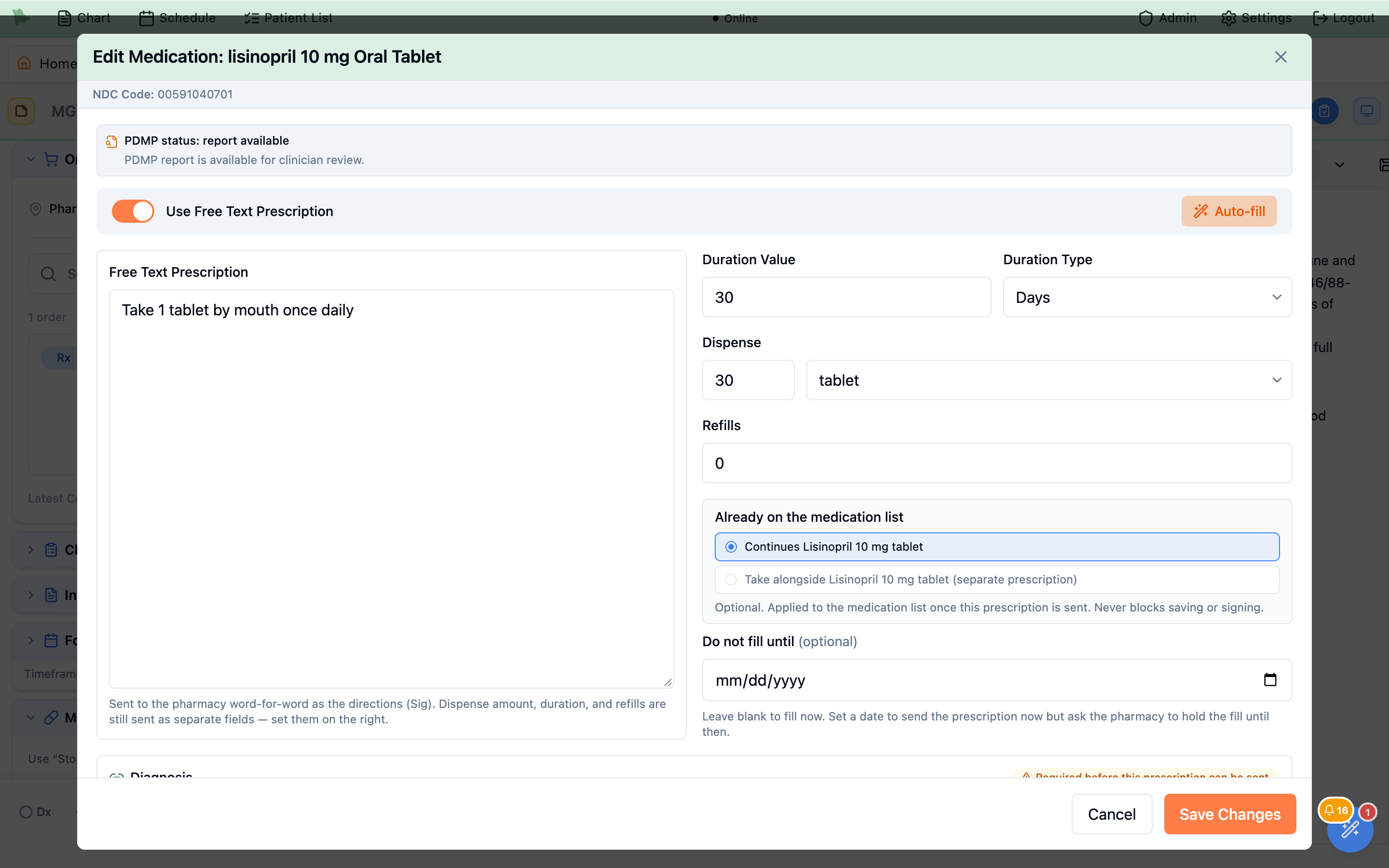
Renew inside a visit. The prescription lands in this visit’s Orders and opens for review, filled in from the last prescription with 0 refills. Continues means it simply renews the entry that’s already on the list.Still taking, Specify and Merge, which apply at once. Queued stops are applied and renewals are sent by Sign & Close Visit. If you close the visit unsigned, they wait in the draft.Build favorites to move faster
Favorites turn the codes and orders you use most into one-click chips. They’re personal to you and appear at the top of the matching section.
Diagnosis favorites
Open Manage Favorite Diagnoses from the gear (or Add favorites). On the Search tab, click a row to add that code to your favorites (the column header says so: “Click row to add to favorites”). The My Favorites tab lists what you’ve saved, with Delete all Favorites to clear the list. Favorites show as quick-add chips under My Favorite Diagnoses.
Order favorites
Click the star on any order to save it, then re-add it later from the Favorites tab in the Search Orders window.
Charge favorites
Use Manage in the Charges section to keep your common CPT/E/M codes one click away. A charge favorite can also carry a place of service: each row in Manage has a place-of-service picker that starts on Don't change place of service — the way every favorite saved before this worked. Set it to 22 (for example) and choosing that favorite documents the code and the place of service in one click, so “the hospital version of 99214” is a single button. If you add a favorite while the visit already has a place of service selected, the new favorite captures it for you.
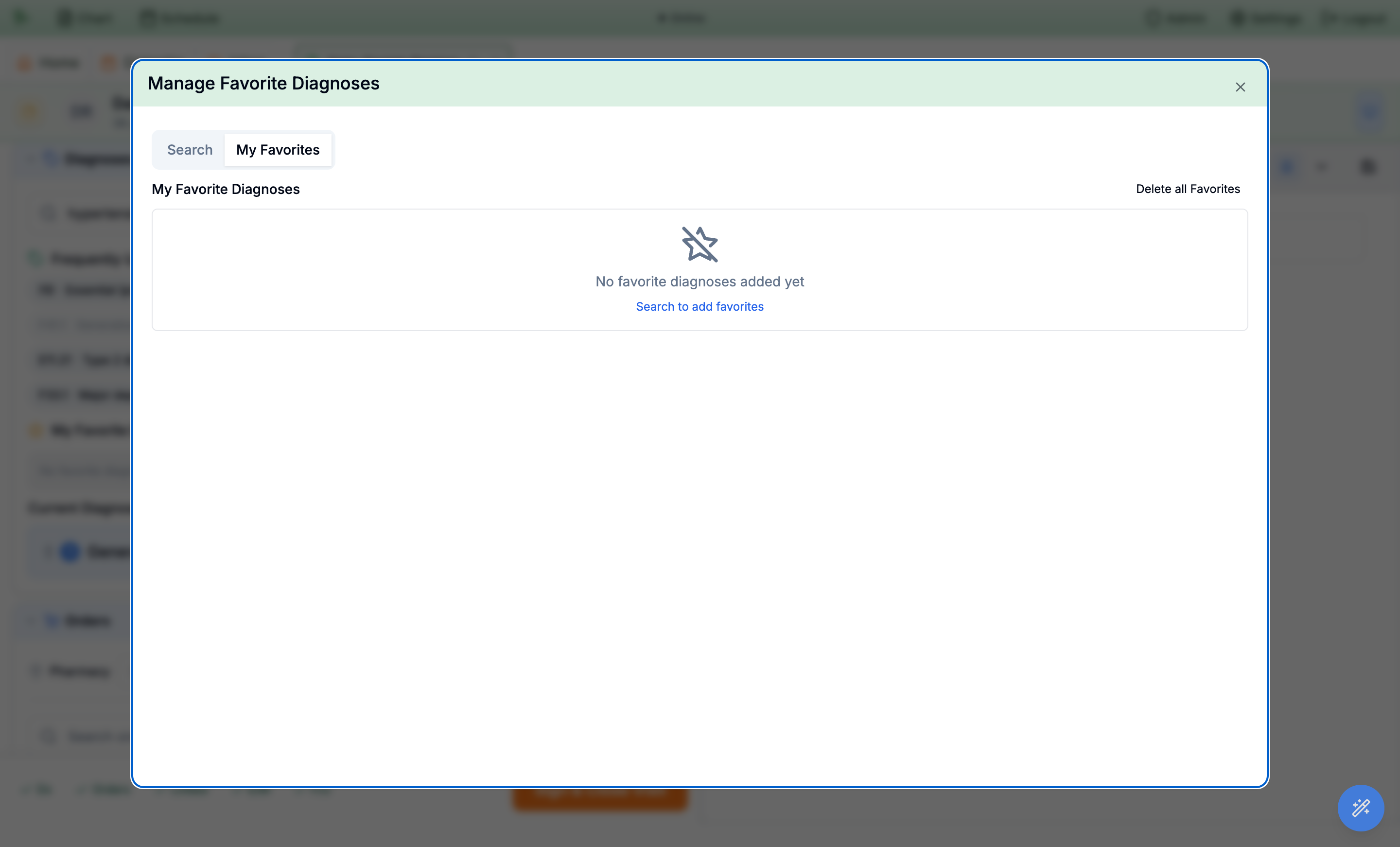
Search tab and it becomes a quick-add chip.Sign and close the visit
Sign & Close Visit finalizes the visit after the signing checks pass. It is the single action that turns your worksheet into a signed, billed, transmitted encounter. The footer chips are a progress hint, not the gate — the real requirements are checked when you click, and anything missing is reported inline and scrolled to instead of signing.
-
Meet the requirements that actually block signing.
- At least one diagnosis. “Encounter requires at least one diagnosis before completion.”
- Charges. An E/M code or at least one procedure code — unless you chose
No chargeorCash pay, either of which satisfies this on its own (see Charges & E/M). - Every order linked to a diagnosis. If any medication, lab, imaging, referral, or screener has no diagnosis association, signing stops and the Associations grid is highlighted.
- A pharmacy, if any prescription is still unsent. “Select a preferred pharmacy before signing since you have unsent prescriptions.”
OrdersandF/Uchips are progress hints only — a visit with no orders and no follow-up signs perfectly well. -
Sign controlled prescriptions first.
Any controlled order must be signed via EPCS before it can be transmitted, and an unsigned one keeps
Sign & Close Visitdisabled until you go back toOrdersand sign it. -
Answer the billability advisory if it appears.
On a visit that will be billed to insurance, Hero EMR checks your diagnosis codes first. If any is a category header or an unrecognized code — a guaranteed clearinghouse rejection — a Some diagnoses can’t be billed as-is dialog opens with one-click billable subcodes. Pick a subcode, or choose
Fix diagnosesto go back to the Diagnoses section.Sign anywayproceeds and records that you acknowledged the codes. This advisory never blocks you, but dismissing the dialog counts as “I’ll fix it” and does not sign. -
Click
Sign & Close Visit. Finalizing signs the note, sends any orders and prescriptions you haven’t already sent individually, submits the charges to billing, applies any medication discontinuations, and creates the follow-up request — in one step. Ctrl/Cmd+Enter does the same thing from the keyboard.
If the open draft belongs to another clinician or is read-only on this device, the sign area explains why it cannot be signed. Resolve that ownership or editing restriction first. A visit dated after today also asks for confirmation before signing; verify the date before proceeding.
Change a visit after you’ve signed it
A signed note is the legal record of the visit, so Hero EMR never lets you type over one. When something needs to change afterwards — a result came back, you forgot to document the counselling time, a diagnosis was wrong — you write an addendum. Hero EMR copies the signed note into a fresh, editable version, you make the change there, and you sign again. The version you signed the first time is kept in full and stays readable.
Everything else about the visit carries on as it was: the encounter keeps its signed date, the charges you already submitted stay submitted, and orders you already sent stay sent. An addendum adds to the visit; it doesn’t reset it.
-
Open the signed visit.
There are two ways in, and both land in the note writer:
- From the calendar — double-click the appointment row (Ctrl/Cmd+click does the same thing). Don’t go looking for the hover ▶ Begin encounter button: it disappears once a visit is signed or complete, and that’s expected.
- From the chart — open the patient, stay on the
Encounterstab, and single-click the visit’s row. The split-pane preview opens with a thin action strip on top of it, readingEncounteron the left and anOpen encounterbutton on the right. Click that. (Double-clicking the row opens the same preview as a full-screen window instead — useful for reading, but it has noOpen encounterbutton, so use the single-click preview when you actually want to get in.)
-
Answer the
Encounter Already Closeddialog. It opens by itself the first time the note writer loads this visit. It reads “This visit has been signed. Create an addendum to reopen the note and update encounter details.”, with a smaller line underneath: “The prior signed note will be copied as a starting point.” Two buttons:-
View read-only— you just wanted to read it. Nothing changes and the visit stays signed. Three things tell you where you are: the note is locked, with a grey chip above it reading “This note is finalized. Use the addendum flow to change it.”; down in the completion footer,Sign & Close Visitis greyed out beside the hint “Reopen this encounter to create an addendum before signing.”; and a smallEncounter signedpill sits at the right-hand end of the patient header strip, just above the note. Click that pill whenever you want the dialog back.- Remember the pill. The dialog is a first-look prompt, not a permanent gate — once you’ve dismissed it, returning to the same visit later in the session opens it quietly, with the pill and no dialog. If you came back intending to amend and nothing popped up, that’s why.
Create addendum— Hero EMR copies the signed note into a new, editable version of itself and hands it to you.
-
- Write the change into the copy. You are now editing a new version of that note, not the signed one. It starts as a word-for-word copy, keeps the same note label and the same position in the visit, and carries over the note’s patient-portal visibility settings, so a note you had hidden from the portal stays hidden. Add your addendum text however your practice prefers — most clinicians add a dated Addendum: paragraph at the end rather than rewriting the body, so the change is obvious to anyone reading later. The left pane is the same Encounter Completion checklist you used the first time, still carrying the visit’s diagnoses, orders, charges, and follow-up.
-
Let completion re-read the note, if you want it to.
Press
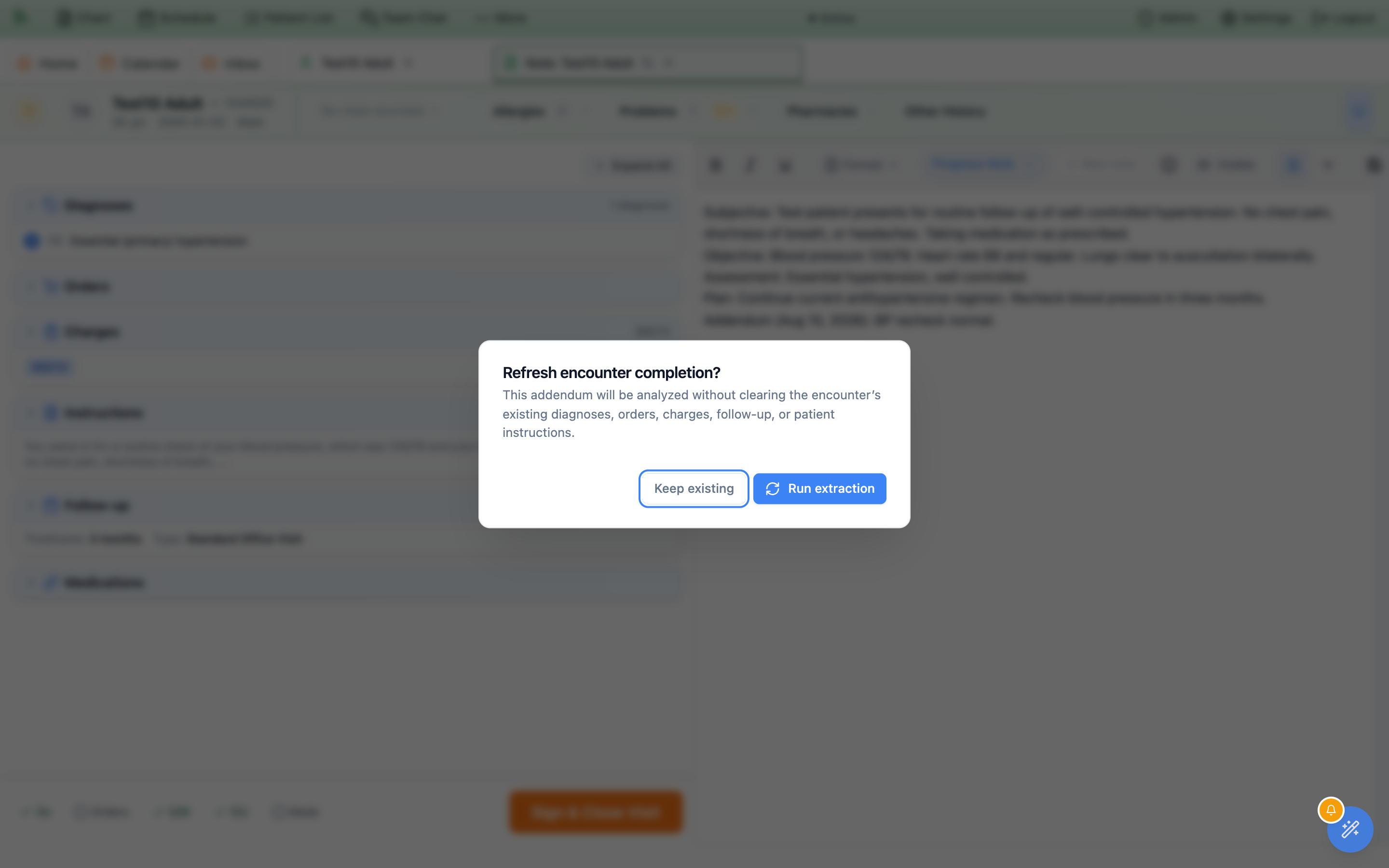
Save Noteand, because the visit already has completion data, theRefresh encounter completion?dialog asks first. On an addendum it says so plainly: “This addendum will be analyzed without clearing the encounter’s existing diagnoses, orders, charges, follow-up, or patient instructions.”Run extractionreads your new text and adds what it finds — a new diagnosis joins the list rather than replacing it, and orders you already sent are never disturbed.Keep existingskips the re-read entirely. Either way you can still edit any section by hand. -
Sign the addendum.
Finish with
Sign & Close Visit(or Ctrl/Cmd+Enter), exactly as you did the first time. The same requirements apply — at least one diagnosis, charges or an explicitNo charge/Cash pay, every order linked to a diagnosis, and any controlled prescription signed through EPCS (see Sign and close the visit). Your addendum becomes the current version of the note, and the version you signed before it is kept underneath it.
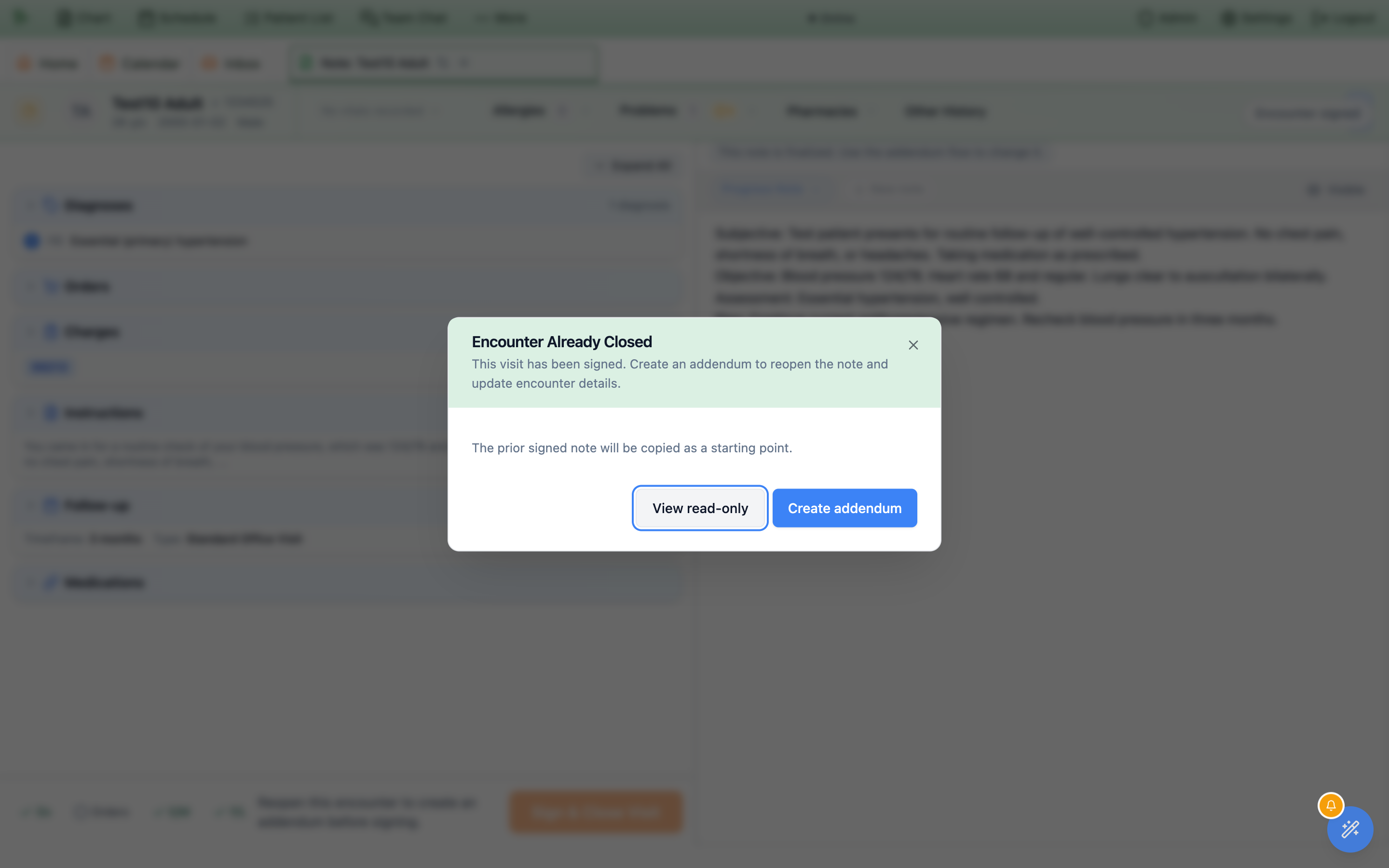
View read-only leaves the record exactly as it is.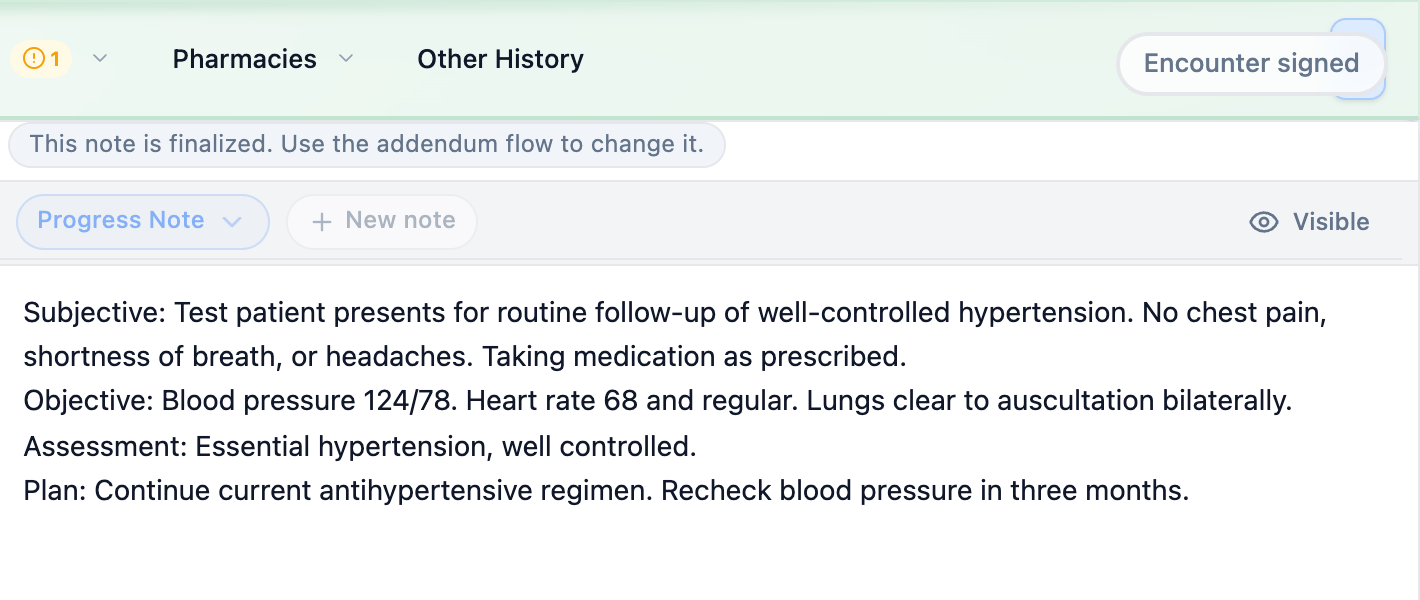
View read-only the note is locked and labelled This note is finalized; the Encounter signed pill on the header strip is how you get the prompt back.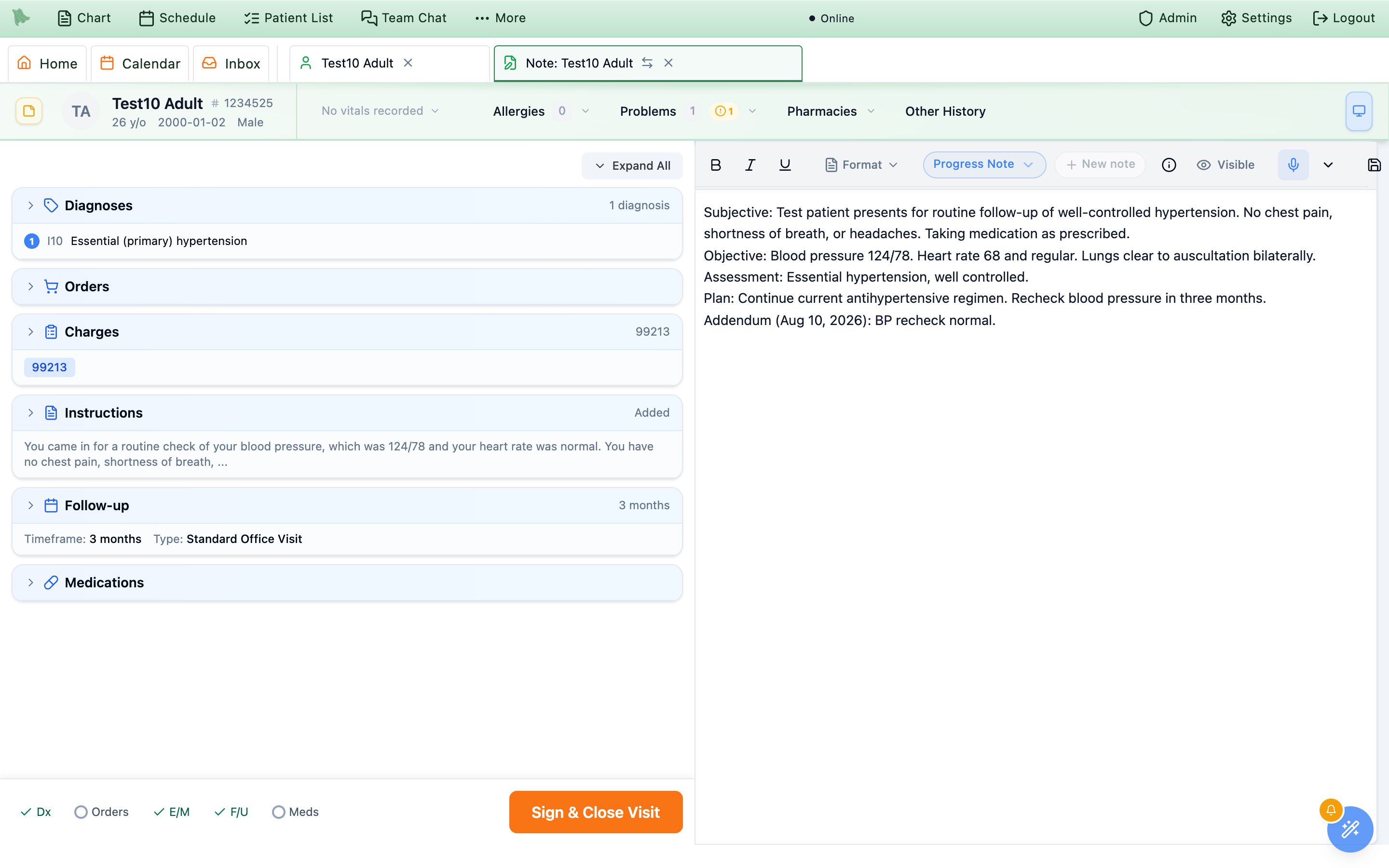
Create addendum, and Hero EMR hands back the draft you were already working on rather than starting a second one — your unsigned text is still there. A visit can only have one addendum open at a time; if you try to amend a different note on the same visit while one is in progress, Hero EMR stops you with “An addendum is already open on another note for this encounter. Finish or discard it before amending a different note.” Finish or sign the one you have, then start the next.
Create addendum; if none is selected, the button sits in a loading state until Hero EMR knows which note you mean. While an addendum is open the other tabs are locked, so you can’t accidentally type your amendment into a sibling note — sign or finish the addendum first, then switch.
Who can write an addendum
Physicians and practice administrators can always create one. Staff accounts need both encounter permissions on their profile:
encounter.amend
Listed in the staff permission catalog as Create addendum drafts on signed encounters. This is the one that unlocks the Create addendum button at all.
encounter.edit_draft
Edit unsigned note drafts. The addendum is a draft note, so without this a staff member could start one but not type in it.
A staff member holding only one of the two sees the same dialog with a different message — “This visit has been signed. You do not have permission to create addenda for signed encounters.” — and only the View read-only button. Ask an organization administrator to add the missing permission to the staff profile (see Staff accounts & permissions). Signing the finished addendum is still a physician action, exactly as it is for a first-time visit.
Discard an untouched addendum
If you opened an addendum accidentally and have not saved or changed it, use Discard empty addendum, then Discard addendum. The signed note remains unchanged. The draft author, the visit’s physician, or an administrator can do this when the draft qualifies. An addendum with structured-data changes may need support review even when its note text looks unchanged.
What the chart shows afterwards
-
One note, not two.
On the chart’s
Notestab the addendum replaces the note it grew from — you see one row for that note, showing the current version, with itsSigned:date. The earlier version isn’t deleted; it’s tucked underneath. The same is true of the note tab strip inside the visit. -
Read the earlier version from
History. Select the note on theNotestab and clickHistory— the clock button in the preview’s toolbar, sitting next toPrint(its tooltip reads View version history). AVersion Historycolumn opens beside the note listing every version by date and time with the author’s name. Click any entry to read that version in full — chief complaint, subjective, objective, assessment, and plan as they stood then. The sameHistorybutton is on the toolbar of the full-screen note window.- Two badges, two different things.
Currentmarks the version you are reading now — that’s the one that tells you which is live.Activeappears on every version whose full text is still stored and instantly readable; once a version passes your practice’s retention window (90 days by default) it is moved to long-term storage and readsArchivedinstead, and has to be retrieved before you can open it.
- Two badges, two different things.
-
Change charges right in the addendum — Hero handles the billing.
Re-reading the note during an addendum leaves the visit’s charges alone, and it does not redraft the after-visit patient instructions. The Charges section stays open in every addendum, so you can add a missed code, fix a modifier, or record time. A short line above it tells you what will happen when you sign:
- Claim not sent yet — your changes update the claim when you sign.
- Claim already sent (or a payment is posted) — the addendum still signs, and your changes go to your billing team for review as a corrected claim. You are never blocked from signing.
draft and clears the signature — signed date, signer, and digital signature all come off, an encounter-level version snapshot is filed for the audit trail, and the visit is unsigned until you sign it again. Its dialog is titled Encounter Already Signed and reads “This encounter has already been signed. You can reopen it to make corrections… A version snapshot will be saved for audit purposes. After making corrections, you’ll need to sign the encounter again.”, with Cancel and Reopen Encounter. It is a correction tool for a visit that was signed in error, not the routine way to add to a finished note — and because it un-signs a visit that has already been billed and released to the patient, reach for the addendum unless you specifically need the signature undone. Staff can never reopen an encounter, whatever permissions they hold.
Addendum, and tapping it asks “This encounter has been signed. Create an addendum?” with Cancel and Create addendum before anything opens. See Encounters on the phone.
Send notes for co-signature: assign a reviewer or set supervision rules
Co-signing is off by default. A practice administrator or user with organization-management access opens Admin → Co-signing, turns on Enable co-signing, selects Who can co-sign, and saves. That is enough for clinicians to pick a reviewer note by note; the other settings are optional and also off until you set them. Turning the feature off prevents new requests; existing requests remain available.
| Setting | What it does |
|---|---|
Enable co-signing | Lets clinicians assign a reviewer, and lets supervision rules send notes for co-signature. |
Who can co-sign | Tick the providers who may co-sign (Search providers narrows the list). Only they can be assigned a request or named in a rule. |
Can see all co-sign requests | Shown beside each ticked co-signer; use it for a medical director. They see every co-signer’s requests in the Inbox, can filter, reassign and cancel any pending one, and read the report for every clinician (Co-sign folder, Co-sign report). Practice administrators can always do this. Unticking someone under Who can co-sign clears the mark. |
Supervision rules | Send a clinician’s signed notes to a co-signer automatically, for example an NP or PA whose notes the medical director reviews. Add rule (available once someone is ticked under Who can co-sign), then choose the Clinician whose notes are reviewed, the Co-signer (a ticked co-signer, never the clinician), and Which notes: All signed notes; A share of signed notes with a percent from 1 to 99 (it starts at 20%); Notes with a controlled-substance prescription; or Controlled-substance notes + a share of the rest with a percent of the other notes (% of the rest). One rule per clinician; the × removes a rule. “Rules apply to notes signed after you save.” Earlier notes are never sent. |
Co-sign within [N] days | Gives each new request a due date: the end of the Nth day after the day it is made, in the practice’s time zone (with 3, a request made on Oct 22 is due by the end of Oct 25). Enter 1 to 365, or leave it blank (No limit) for no due date. Reassigning keeps the date, and a request keeps its date if you change the setting later. |
Allow co-signing several notes at once | Co-signers can select pending notes in the Inbox and co-sign them with one statement after confirming they reviewed each one. |
Default co-sign statement | The statement co-signers start from; Use Hero default restores Hero’s wording. Co-signers can use one of their own dotphrases and edit the statement before signing. |
The window checks the rules before it saves, for example “A rule’s co-signer must be checked under Who can co-sign.” or “A clinician cannot co-sign their own notes.” To untick a co-signer a rule names, change or remove that rule first.
How a note reaches a co-signer
- Assign a reviewer from the desktop sign button. Open
More signing optionsbeside the sign button and chooseAssign co-signer…. Search for an eligible provider other than the note’s author. - Choose
AssignorAssign & sign. The first saves the reviewer choice; the second also starts your usual sign workflow. Before completion,Change co-signer…andRemove co-signerare available when you have access. A signed note also offersRequest co-sign. - Or let a supervision rule send it. When a clinician with a rule signs a note for the first time, Hero sends it to the rule’s co-signer: every note under
All signed notes, or, under a share, notes picked at random one by one, so nobody can tell in advance which will be picked. A rule covers every note the clinician signs in Hero, not only visit notes. Addenda and later versions, appointment cancellation and screening notes, and imported notes are never sent. A reviewer assigned before signing is kept, and a rule never sends the same note twice. - Controlled-substance rules. Under
Notes with a controlled-substance prescription, a note is sent when its visit has a C-II to C-V prescription written in Hero that is signed, sent, or waiting for a supervising physician’s signature; the prescriber does not have to be the note’s author. A refill sent from the Refill Center counts for its refill note. Drafts, cancelled, errored and deleted prescriptions, pharmacy requests nobody has answered, and imported medication history never count. If the prescription is signed after the note (for example, the EPCS approval comes in later), the note is sent at that moment, as long as it was signed after the rule was saved and has never been sent by a rule. UnderControlled-substance notes + a share of the rest, every controlled-substance note is sent and the other notes are picked at random at the percent you choose. - The reviewer opens the request in the Inbox. In the
Co-signfolder, read the full signed note as well as theAI summary. UnderStatement source, choosePractice defaultor one of your dotphrases, editCo-sign statement, then pressCo-sign note. Due dates, filters, co-signing several notes at once, and theAll co-signersview are in Co-sign folder; the monthly report is in Co-sign report.
Rule in the Inbox, or Rule · controlled substance when a controlled substance was prescribed in the visit. The note’s author cannot remove it or move it to someone else: “A supervision rule requested this co-signature. The co-signer or a practice administrator can change it.” The assigned co-signer, a co-signer who can see all co-sign requests, or a practice administrator can reassign or cancel it from the Inbox.While a signed note waits, it shows Awaiting co-sign · Ana Rivera; once co-signed, Co-signed · Ana Rivera, which opens the date and the statement. Co-signing is a separate review of a signed note; assigning a co-signer does not replace the author’s signature or make an unsigned draft complete.
Sign a visit documented by an attached outside note
When your own note for this visit is already attached as an outside note, you can use that document as the visit’s documentation without signing an empty or duplicate Hero draft.
- Verify the attachment belongs to this visit. Encounter Completion names the attached outside note. Choose
Use the outside note as this visit’s documentation — don’t sign my draft note. - Read
Use the outside note only?. It lists drafts that will be removed when you sign, including whether they contain writing. Confirm withUse outside note only. If there is no draft, there is nothing to remove. - Review diagnoses, charges, and orders, then sign the visit. The outside-note choice does not discard those structured details or bypass the other signing checks. If a draft or attachment changes after confirmation, Hero asks you to review the choice again.
Use Sign my visit note if you want to sign the Hero draft instead. An unrelated outside record is not a substitute for your documentation of this visit.
Video visits: say where the patient was
A video visit is billed differently when the patient was at home than when they were somewhere else (place of service 10 or 02), so Hero asks one plain question, Where was the patient?, and remembers each patient’s answer for their next video visit. You never have to pick a code for it.
-
Find the chip in the note.
On a video visit, the note toolbar shows a chip just before the date of service:
Patient at home,Patient not at home, or, in amber when nothing is known yet,Patient location?. Hover it to see where the answer came from: this visit, From this patient’s last video visit ({date})., or Your practice’s default. -
Click it to answer or change it.
Choose
At home(Their home or another private residence) orNot at home(Work, school, a car, a clinic or another facility). One click saves it. A suggested answer shows where it came from, for example Suggested from the visit on Oct 2. -
Sign as usual.
Signing records the answer the chip shows. Only when Hero knows nothing at all (no answer on the visit, no earlier video visit, no practice default) does
Sign & Close Visitask Where was the patient during this video visit?: “This decides how the visit is billed. Hero remembers it for this patient’s next video visit.” Picking an answer saves it and signing goes on;Cancelleaves the visit unsigned.
After signing, the chip is read-only (Recorded when the note was signed.). The question is only asked for a billed visit: not on an addendum, a No charge visit, or a visit whose Charges already name a different place of service.
Place of service 12 on a video visit
In Charges, place of service 12 is labelled Home, in person (12): it means the clinician was at the patient’s home in person. If 12 is chosen on a video visit, Charges warns “Place of service 12 is for an in-person visit at the patient’s home. For a video visit with the patient at home, answer ‘At home’ under ‘Where was the patient?’ (place of service 10).” and offers Use “At home” (10) instead, which clears the 12 and records At home. On an addendum the button reads Use “Telehealth, patient at home (10)” instead. The warning never blocks signing; billers see the same warning on the claim.
The practice default
In Billing → Configuration → Claim Submission, Telehealth patient location default is used only for a patient with no earlier answer: No default: clinicians answer for each patient, Patients join from home — POS 10 (non-facility rate), or Patients join elsewhere — POS 02. The claim must match where the patient actually was, so clinicians still change the chip whenever the default is wrong.
Need help? Email support@heroemr.com.